
 Available in US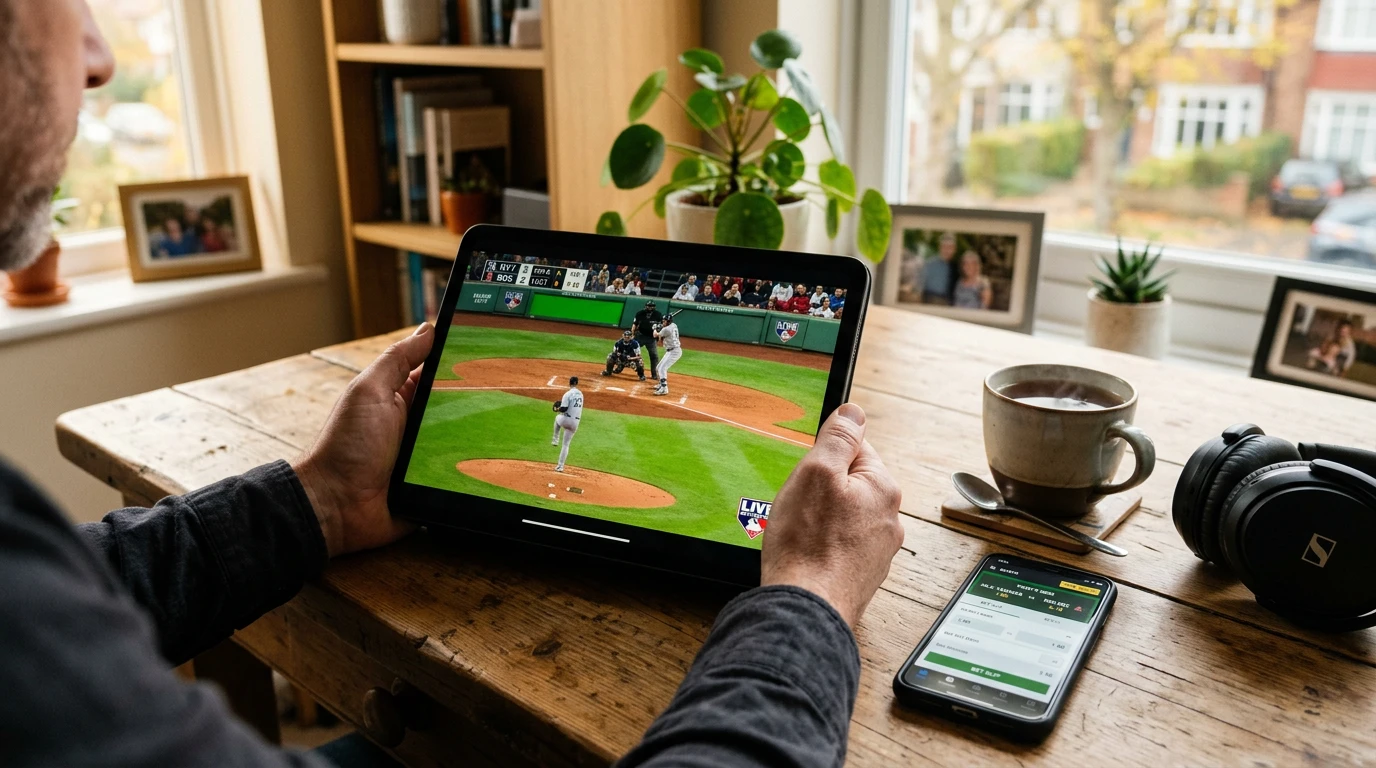
- MLB.TV International as the default — Configuring MLB.TV for Low-Latency Live Betting
- UK broadcast deals and free options
- Latency and the live betting risk it creates
- Radio feeds and audio-only backup
- Mobile data, public Wi-Fi and reliability
- Integrating the stream into a betting workflow
- Putting the streaming setup in its proper place
The first time I tried to live-bet a Yankees game from a flat in Bristol, I was streaming through a free pirate site, the picture was buffering on every other pitch, and the sportsbook’s in-play interface had already paid out a strikeout I had not yet seen happen. That afternoon ended badly enough to be educational. Reliable streaming is not a luxury for UK MLB punters; it is operational infrastructure. The question is which platform, at what cost, with which limitations, and how to integrate the feed into a betting workflow that does not constantly leave you ten seconds behind the live odds.
MLB.TV International as the default — Configuring MLB.TV for Low-Latency Live Betting
MLB.TV International is the official option for UK fans who want comprehensive coverage. The annual subscription includes every regular-season game, with both home and away broadcast feeds, on-demand replays, and a tolerable mobile app. The picture quality on a decent home broadband connection is high definition without buffering, and the commentary teams are the same ones American viewers hear, which adds context that British football-style commentary would not provide.
The limitations are real but manageable. Some games are blacked out for territory reasons when MLB has sold UK broadcast rights to a specific partner, although these blackouts are rarer in 2026 than they were five years ago. Postseason coverage requires checking the platform notes carefully – some series are excluded from the standard MLB.TV package and bundled into separate playoff add-ons. For year-round MLB punters, the cost works out to under £1.50 per game across a full season, which is unambiguously good value if streaming improves your decision quality even modestly.
UK broadcast deals and free options
Beyond MLB.TV, UK terrestrial and pay broadcasters carry occasional MLB content. The London Series is typically broadcast on free-to-air television with substantial promotional support. Selected postseason games, particularly the World Series, sometimes appear on UK sports channels with their own commentary teams. These deals shift season by season, and the contractual arrangements are not always made obvious to fans, so checking the broadcaster line-up at the start of each MLB season is worthwhile.
Free streaming options exist but come with serious caveats. Pirate streams are illegal under UK law, expose your devices to malware, and are uniformly unreliable for live betting because of erratic latency. The legal free options – primarily highlight reels and condensed games on YouTube and the MLB official website – are useful for catching up on results, not for live wagering. Around 22 million people in the UK regularly engage with sports gambling, and within that population, the punters who treat streaming as part of their analytical setup tend to outperform those who treat it as decoration.
Latency and the live betting risk it creates
Every video stream is delayed relative to the actual event. Broadcast television runs around 5 to 15 seconds behind real time. Internet streaming runs further behind, typically 20 to 60 seconds depending on platform and connection quality. Sportsbooks, by contrast, receive game data through professional sports data feeds that arrive within a second or two of the live action. The result is that when you see a pitch on your screen, the sportsbook has already moved its in-play odds based on the result of that pitch – sometimes the pitch after.
The practical implication is harsh. You cannot reliably live-bet by watching the screen and pressing buttons after each pitch. The market will already have repriced. Punters who attempt to scalp live odds based on streaming visuals are systematically late, and the losses compound across hundreds of small bets. The professionals who live-bet successfully use real-time pitch-by-pitch data feeds, often through the sportsbook’s own in-play interface, and treat the video as confirmation rather than primary input. The pricing of betting on baseball – like all live markets – penalises information lag mercilessly.
Radio feeds and audio-only backup
Radio broadcasts are an underrated tool for UK MLB punters. MLB Audio is included with most MLB.TV International subscriptions, providing live radio commentary from both home and away teams for every game. The latency on audio feeds is typically lower than video – often 10 to 20 seconds – and the lower bandwidth requirements make audio reliable on mobile data, on poor connections, and during travel.
The genuine value of radio is in the second screen workflow. Run audio in the background during the workday, follow the game state through the sportsbook’s in-play data, and use the radio call for context when you decide whether to take a live position. The combination of audio and live data gives you a workable real-time read on the game without the latency penalty of video. Some of the most experienced UK MLB bettors I know never watch the games at all during the regular season, working entirely through audio and data because the workflow is faster and the decisions are cleaner.
Mobile data, public Wi-Fi and reliability
Streaming MLB on mobile data is feasible but expensive. A standard-quality stream consumes roughly 1 to 2 GB per hour, which means a full nine-inning game on 4G can easily eat 3 to 5 GB of your monthly allowance. For pub viewing or commute live-betting, this matters. The newer 5G networks handle the bandwidth better and offer lower latency, which has secondary benefits for live betting workflows that involve checking odds in the seconds after a key pitch.
Public Wi-Fi is not safe for sportsbook activity. Even setting aside the security concerns of placing bets over open networks, the bandwidth is shared, the latency is unpredictable, and many UK pubs and cafes intermittently drop streaming connections for buffering. If you are placing meaningful wagers, do it from your own connection, on your own hardware, with notifications enabled so you can react to in-play markets when the situation calls for it. Treat your home setup as your primary betting environment and mobile workflows as supplementary. Following the principle that responsible gambling tools and limits should be the foundation of any UK punter’s setup, the same logic applies to your streaming infrastructure – reliability and security matter as much as picture quality.
Integrating the stream into a betting workflow
The setup that works for me, refined over several seasons, runs three screens. The main monitor shows the MLB.TV stream with the home broadcast feed muted because I prefer the away team’s commentary. The laptop shows the sportsbook’s in-play interface with pitch-by-pitch data and live odds. The phone has a notes app open for logging bet IDs, stake sizes, and any live wagers I place. This sounds elaborate but compresses to one routine that becomes invisible after a few weeks.
The discipline is to treat the stream as the slowest of the three inputs. Decisions to bet live are based on the live data feed and the analysis I prepared before first pitch. The video confirms the context but does not drive the decision. New punters tend to invert this – they let the visual drama of a tense at-bat push them into bets they would not have taken from cold data, and the latency penalty compounds the bad decision. Around 60% of UK bettors regularly check multiple sportsbooks for the best odds, and the streaming setup is what makes that comparison possible in real time without losing track of the game itself.
Putting the streaming setup in its proper place
Reliable streaming improves a UK MLB punter’s life, but it does not by itself improve results. The bets that win are still the ones priced correctly against the underlying probabilities, regardless of whether you watched every pitch live or read the result the next morning. Build a streaming setup that lets you watch the games you want to follow, accept that some games will be background audio while you sleep, and resist the temptation to treat live viewing as proof that a live wager is justified. The technology is a tool. The edge comes from the analysis behind the bet.
Articles
Created by the "tipsbettingb" editorial team.
