
 Available in US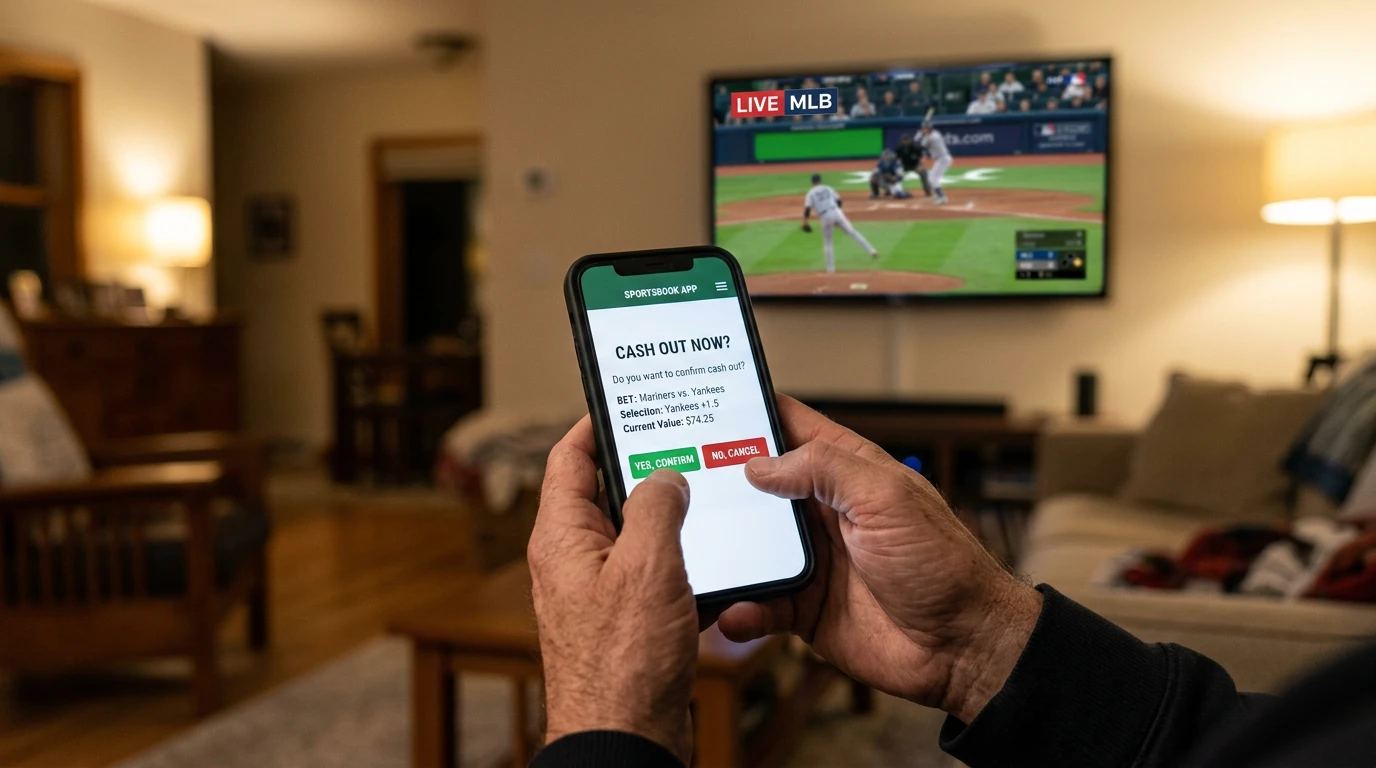
Cash out is the feature that most often turns small wins into smaller wins and big wins into mediocre wins. I have lost count of how many MLB tickets I have either accepted or declined a cash-out offer on, and the lesson I have absorbed across nine years of doing it is that the feature is neither the salvation nor the trap that competing camps describe. It is a pricing mechanism the sportsbook offers, and like every other pricing mechanism, it has expected value. The job of the punter is to recognise when the offered cash-out price genuinely beats the position you are holding and when it shaves your edge in exchange for the comfort of certainty. This article is the framework I actually apply when the cash-out button starts blinking.
How cash out pricing works under the hood — Calculating Bookmaker Margins on MLB Cash-Out Offers
When a sportsbook offers a cash-out price on your live wager, it calculates the current implied probability of your bet winning based on the live market state, takes the potential payout, and discounts it by a margin. The margin is what compensates the sportsbook for taking the position back. Typically the discount on cash-out offers ranges from 5% to 15% relative to the fair value implied by the live odds, depending on the operator and the market. On highly liquid markets close to settlement, the discount can be smaller. On illiquid markets or in volatile spots, the discount widens.
The mathematical implication is direct. If the current live odds suggest your bet has a 70% chance of winning at the original payout, the fair cash-out value is roughly 70% of the potential payout. The sportsbook will offer you something closer to 60% to 65%. That gap is the operator’s margin on the cash-out transaction, and it is structurally negative expected value for the punter relative to letting the bet ride. The fact that cash out exists at all reflects how heavily punters value certainty, because in pure expected value terms, accepting cash out always loses you money on average.
Partial cash out mechanics and where it sits
Many UK-licensed sportsbooks now offer partial cash out, allowing you to take some money off the bet and let the rest ride. The mechanic is essentially the same as full cash out except applied to a fraction of the wager. The same sportsbook margin applies, so partial cash out is also negative expected value relative to letting the full position ride to settlement. Where partial cash out earns its keep is in scenarios where bankroll management or psychology genuinely matters more than maximising expected value.
A worked example: you placed a £100 wager on the Yankees moneyline at +150, which would return £250 if it wins. The Yankees lead 5-1 in the seventh, and the sportsbook offers a £180 full cash out. Partial cash out at 50% would lock in £90 (the proportion of the £180 offer corresponding to half the original stake) and leave £50 of stake riding for the remaining payout if Yankees hold on. Whether the partial path makes sense depends entirely on whether the certainty of locking in £90 of profit against your £100 stake outweighs the small EV cost. For small recreational bets, almost never. For positions that are large relative to your bankroll, sometimes yes.
Situations where cash out genuinely fits
The cleanest case for accepting cash out is bankroll smoothing on outsized positions. If you accidentally placed a wager that was larger than your bankroll allocation rules allow – it happens – and the bet is heavily in your favour, cash out can right-size your exposure without you having to sweat the back end of the game. The expected value cost is real, but it pays for variance reduction on a position that should not have existed at the original size.
The second clean case is information change. If you placed a pre-game wager and a critical piece of news has emerged after the game started – a starting pitcher leaving with apparent injury, a thunderstorm rolling in to potentially shorten the game, a key player ejected – and the sportsbook has not yet adjusted its cash-out pricing to reflect the new probabilities, you can occasionally find offers that beat the true updated value of your position. These windows are short and require active monitoring, but they exist. The third case is psychological capacity: if a bet is genuinely affecting your decision-making on subsequent wagers, accepting a cash-out and clearing the cognitive load can be worth more than the EV cost. This is hard to admit and important to recognise honestly.
Situations where cash out erodes edge
The everyday pattern that costs UK punters money is reflexive cash-out acceptance whenever a bet looks shaky. The Yankees go up 4-0 in the third, you take the cash-out at +£60 against a potential +£100, and the game ends 7-3 Yankees as expected. Across hundreds of repetitions of that pattern, the cash-out tax compounds significantly. The MLB regular season is 162 games per team, which means the volume of opportunities to either take or decline cash-out offers across a season is enormous, and the cumulative drift from negative EV cash-outs is one of the more underdiscussed leaks in retail betting.
The other pattern that erodes edge is panic cash-outs on positions that have moved against you but where the original analytical case remains intact. The opening pitcher gives up two runs in the first, the cash-out price drops to 30% of the original payout, and you accept it because the bet feels lost. Often the original assessment of the game has barely changed – first-inning runs do not invalidate a starter’s expected performance over six innings – and the sportsbook’s pricing of your bet is more reactive than the underlying probabilities warrant. Holding through that volatility is part of disciplined betting, and the punters who understand this leak tend to outperform the ones who treat the cash-out button as an emotional escape valve. As one experienced bettor put it, the easy money is gone the moment you start treating each game as a separate emotional event rather than a draw from a long-run distribution. The most common mistakes beginners make in MLB betting includes this pattern at or near the top of the list.
Cash out versus live hedging
The alternative to accepting a cash-out offer is constructing your own hedge in the live betting markets. If you have a £100 wager on the Yankees at +150 and you want to lock in profit with the Yankees up 5-1 in the seventh, you can either accept the £180 cash-out or place a live wager on the Red Sox at whatever the current live moneyline is. The hedge is more flexible because you control the exact position and the exact amount, but it requires you to understand the live odds well enough to construct it correctly.
The expected value comparison usually favours the hedge over the cash-out because the live market itself has a smaller margin than the additional cash-out margin. If the live moneyline implies a fair cash-out value of £200 and the sportsbook offers £180, a live hedge constructed at the live odds will typically yield something closer to £190 to £195 net. The trade-off is operational: cash out is one click, while a live hedge requires calculation, market access, and the time to place the wager before the line moves. For punters who are already set up to live-bet smoothly, hedges tend to be the better tool. For punters who want simplicity, cash out is acceptable as long as you recognise the cost.
Building a personal rule for cash out decisions
The rule I apply, refined across many years, is simple. I never accept cash out on a position that is at or below my standard bankroll allocation – those bets ride to settlement regardless of the offer, because the variance is exactly what the bankroll is sized to absorb. I will consider cash out on positions that are oversized relative to my normal allocation, where the certainty has genuine value beyond pure EV. I will consider cash out when material information has emerged that changes the probabilities and the sportsbook has not fully adjusted. I never accept cash out simply because the bet looks tense or because I want to feel relieved.
The rule reduces decisions on cash-out offers to a small number of specific scenarios rather than treating every flashing button as a fresh analytical problem. That reduction in decision load is itself valuable. The MLB season produces hundreds of opportunities for cash-out decisions, and the punters who handle them with a fixed framework rather than emotional reactions accumulate meaningful edge over the course of a season. The button is a tool. Like every tool, it is useful when applied to the right job and damaging when used as a substitute for the discipline it cannot replace.
Articles
Created by the "tipsbettingb" editorial team.
